.
SPECIAL FORCES IN COUNTER-TERRORISM ENGAGEMENT. VI
.
Welcome back. Let’s get started – Specialist Skills Training
Secret Intelligence Service
.
“Severe, denotes the level of very dangerous threat of terrorist act/s perpetrated against us, – this increasing at a rapid rate. It is the only perception.” (C-I)
.
“Over the last year the rate of arrests has increased dramatically. We are arresting about one person a day for terrorist offenses. It is indisputable that we have disrupted some very serious plots and certain of these cases are going to the courts.” Police Commissioner. Sir Bernard Hogan-Howe
“The Islamic State presents the most severe terrorist threat and each day that it exists it grows stronger; its vile ideology becomes more entrenched and via clever manipulators, grows more attractive to ever more young and made disaffected Muslim men across the world. They are not drawn to the group’s religious doctrine so much as the opportunity offered to join a cause that allows them to feel powerful, as opposed to the supposed powerlessness of their current predicament, this, in a world they are told and subsequently come to very wrongly believe, is underpinned by the anarchy of a free market; that breeds for them only poverty, despair, and injustice.” (C-I)
.
.
New Section Preamble: Mental and Physical – So you think you are tough?
.
Operational Field Skills. A few quick tips on how to survive and remain unnoticed during exploration (covered in detail elsewhere, by necessity. C-I)
1. To silently sneeze or cough if you can not help it, should be by widely open mouth, breathe out as much air from the lungs, and, covering mouth and nose with a crumpled cloth, cough or sneeze, do not breathe this new portion of air.
2. If you need to gently release gases you should push your buttocks with your fingers, and then to not impersonate the smell quickly, dispel the air strides with a palm, without producing rustles.
3. To silently crawl from place to place, move by using the tips of the fingers and toes, in which the body is in contact with the floor or ground.
4. In order to quietly catch your breath, should open your mouth wide and extend the throat as if yawning.
5. In order to facilitate removal of vomit you should strongly press the fingers of two hands on the solar plexus.
6. In order to reduce the odor emanating from ammunition, it is rubbed with grass and soil. New clothing should be boiled in the infusion of herbs.
7. To reduce the amount of debris and traces of feces; bury, drown in the waters or throw away to the side of the trail.
8. The water can be heated with hot stones, throwing it into the tank, created out of the pit, and a polyethylene film.
This tank can also be stored for a long time – quietly drinking water supplies.
9. It often happens that the water is not enough just to boil, you should also use a bactericidal grass, making a de-coction of them.
10. Water from puddles or hemp, the surface of which does not spread the spit, is not suitable for drinking.
11. In order for the water cord tensioning the tent, not trickled down to the flat, across the cord attache a wand through which water will flow down. This applies to those cases where the ends of the cord are attached to the trees and place attachment above the cord attached to the tent.
Operational Field Skills. The determination of the horizon by using the sun and a watch
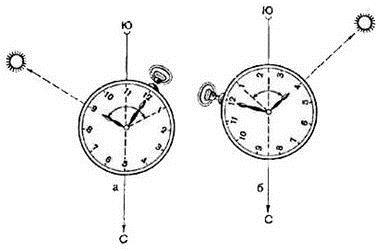
According to the Sun, and hours hand, the horizon is defined in the following sequence: hours held horizontally so that the hour hand is aimed at the sun, the angle between the hour hand and the direction of the center of the dial 1 figure split in half. The line that divides the angle in half, and will indicate the direction to the south.
Before noon, you must halve the arc (angle) on the dial, which is the hour hand which has to moved to 13 hours, and in the afternoon – an arc, which you took after 13 hours.
 Easy!
Easy!
.
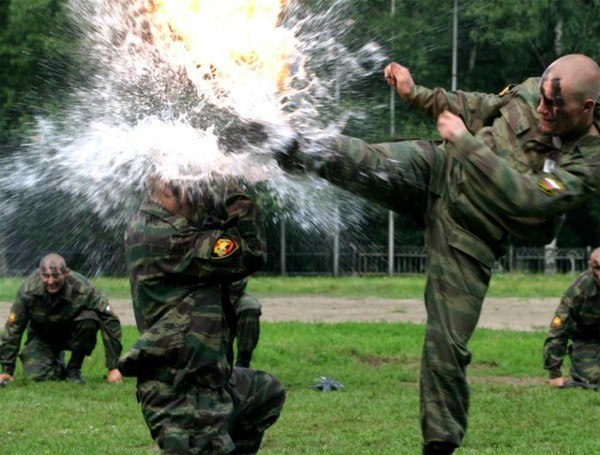
Knife Fighting Scrapbook (C-I)
.
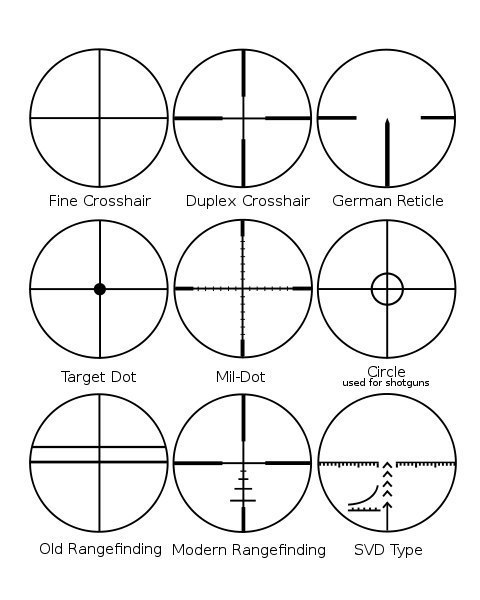
Operational Field Skills. Types of sighting nets used in the optical sight :
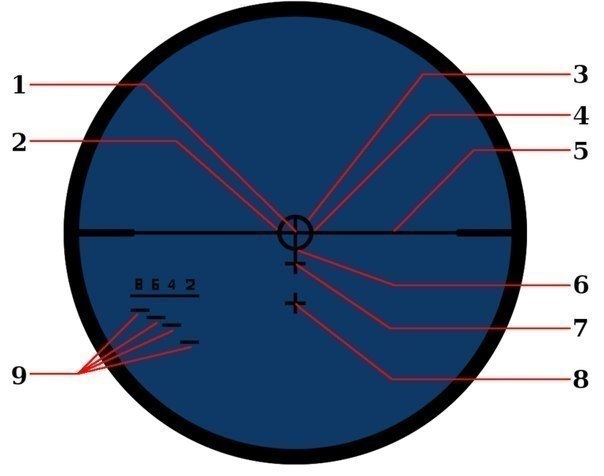
Sniper scope
What are the markings on the sighting grid sniper scope?
1. The aiming point for shots at a distance of about 200 m.
2. The point of aim at targets that are moving from left to right at a speed of 8 km / h, a distance of about 200 m.
3. In this circle people rising 1.75 m. 400 m.
4. The point of aim at targets that are moving from right to left at a speed of 8 km / h, a distance of about 200 m.
5. Line to determine deviations from the horizon.
6. aiming point for shots at a distance of about 400 meters.
7. aiming point for shots at a distance of about 600 m.
8. aiming point for shots at a distance of about 800 m.
9. Height human growth 1.75 m., At distances of 800, 600, 400 and 200 m
.
.
Operational Field Skills. In brief and covered in depth in the Section by (C-I) :
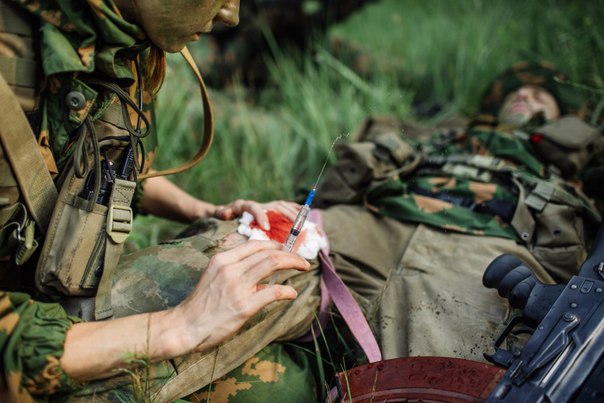
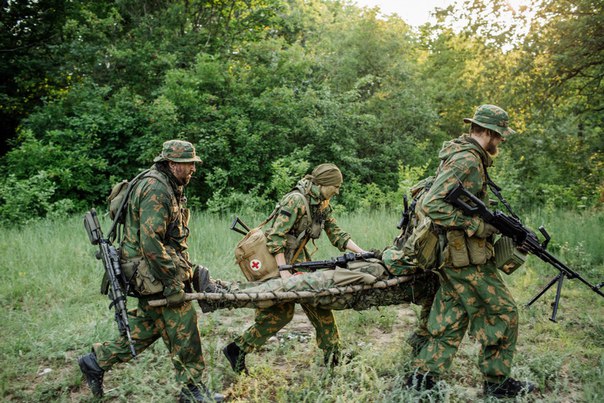
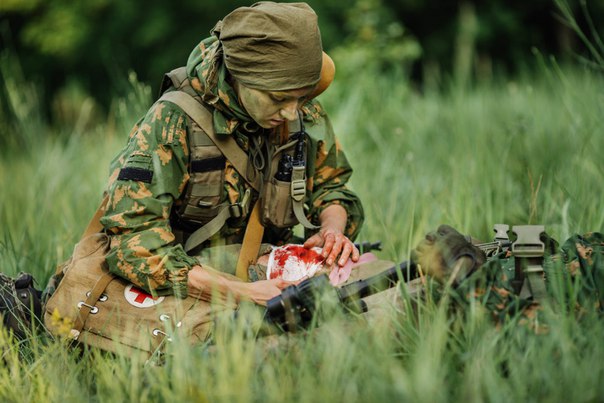
SURVIVAL KILLS : THE STITCHING OF WOUNDS, processing and removal of sutures in the field :
If you think that a woman’s sewing is busy, you will have exactly two hours to change your mind, until tissue wounded limb with a tourniquet will not wither away.
We recommend that in any campaign you must always carry a sewing kit, fishing line or string to the teeth, with which you can always sew up a wound in the field before coming to the hospital, – a very quick stop of heavy bleeding.
ATTENTION
Stitching wounds is only a temporary measure to stop bleeding which is very heavy. Since at this place of the seam necessarily arises secondary infection, after suturing it is vital to attend at the emergency room.
HOW TO SEW A WOUND
If you do not know anything about excision wounds do not even try to sew it. Before suturing the wound, remove all the dead, dirty, bloodstained cloth length from the floor up to 2 centimeters. Healthy tissue can be distinguished by the characteristic muscle contractions at a pinch with forceps or by means of chemical indicators, giving shade of brown necrotic tissue. When excision is to follow, the contraction of the wall and the wound edges are perfect for each other.
The stitches to the wound can only be sterile. However properly sterilized gash in the field is not possible, so we can not take in the wound tightly, leave a couple of millimeters to depart pus and dead tissue, if the wound gets anaerobic infection, it will develop severe sepsis (typical for stab and incised wounds not treated with hydrogen peroxide). Better yet, instead of stitching a wound to try to reduce its size by pulling the ends, but again, not tightly.
Correct processing before suturing the wound; use peroxide, iodine or brilliant green, – remember that these tools can only handle around the wound, it is impossible to put these substances into the bloodstream. If you learned to sew up the wound, then make sure that you have in your medicine cabinet a vial with a sterile needle and thread. What do you need to sew up the wound? Well, again, suturing wounds is a last resort, if a huge wound on do so without hesitation Only sew the wounds which are impossible to apply a tourniquet, and tampons and ordinary bandages do not help.
Better suited for suturing wounds is silk thread, if other than nylon, nylon and their analogues like fishing line or dental floss do not, nodes must be at least 3 to eliminate the risk of unleashing a thread in the wound. Soak the thread and needle in alcohol, and the latest addition over the fire ignited and preferably bend, ideally in the form of “C”, you are not going to stitch when using a needle for stitching wounds as if you were darning socks. As a holder for the needle will go disinfected tweezers or pliers.
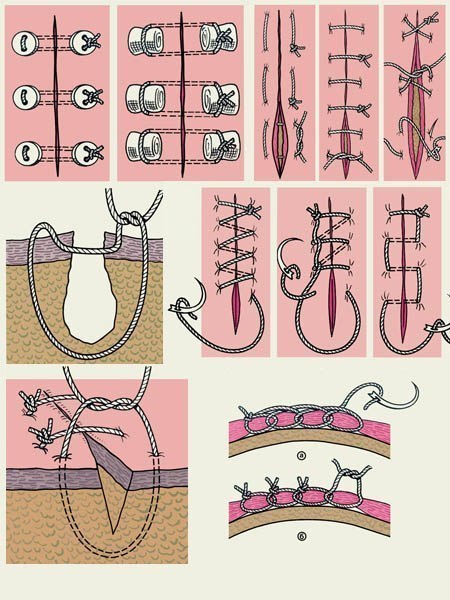
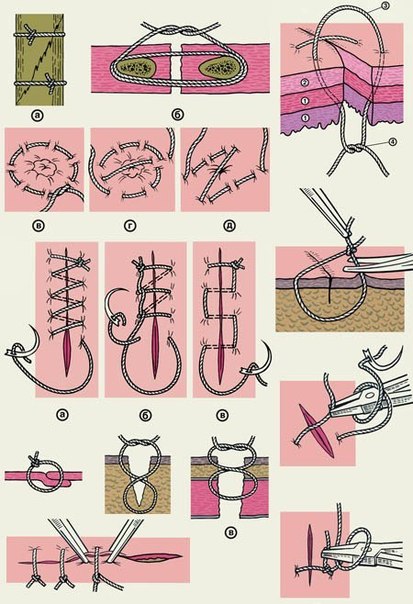
Suture wound properly with the center. The second seam is in the middle of the center and one of the edges of the wound. Tongs hold needle which is punctured skin to 6 mm from the edges of the wound and the stitch held by the wound while the forceps hold the wound edges together.
After each stitch you need to impose nodes but not on the wound, but on healthy skin. After the procedure, one end of the cut, the other left half a centimeter to the seam can be removed.
Different types of stitches and knots can be found in the pictures below.
HOW TO REMOVE THE JOINTS
Seams should be also able to shoot properly. It is best to ask a professional to do this, but remove the stitches sewn to wounds after healing is possible and independently. Disinfect tweezers, scissors and sutures, cut them along the edge of one previously little string pulling by forceps from a wound, cut it below the place where the line between the part of the yarn wound in and out, and the need to fully pull the thread on the other end, a sharp movement all of these warnings so that part of the thread that has been on the skin and which probably already has the infection is not passed through the tissue, infecting them. If during removal of sutures, they will diverge immediately then stop this activity and go to the emergency.
.
Operational Field Skills. Gauges of firearms
Gauges of firearms
The gauges of weapons developed historically and, despite numerous unification, is of great variety to say the least. In most countries, the so-called common metric system, according to which the calibre rifled firearms are measured in millimeters (mm). However, in the UK and the USA remains the traditional gauge measurements in fractions of inches. Inches (from Holland. Duim, literally – the thumb).
1) longitudinal length unit in the British measures
d = 1.12 ft = 0.0254 m
2) Russian dometrich. unit of length
d = 1.12 ft = 10 lines = 2.54 cm
Foote (Engl. Foot, the letters. – Foot), a unit of length in the British measures, denoted by ft.
1 f = 12 inches = 0.3048 meters
Calibre (same in fr. – Calibr) – the diameter of the barrel of firearms as well as the diameter of the projectile (bullet), expressed in inches, lines (0.1 inches) millimeters. And in the United States accepted the designation in hundredths, as in the UK -to thousandths. Gauges recorded in the form of a decimal after the point. Symbols of some rifle calibers are listed in the table.
There is a certain tolerance: not all inch designations correspond exactly to the arithmetic recalculation inches
Millimeters. One indication may correspond to multiple values caliber: for example, the English and .450 correspond to 11.56 mm “Webley-Scott,” and 11.6-mm. This is due to different historically developed methods of measurement gauges.
The difference measurement methods lead to different designations of calibre of the cartridge. Thus, by measuring the calibre of the barrel rifling in the fields 9mm calibre cartridge PM is 9 mm, and when measuring the diameter of the bullet – 9.2 mm (generally the diameter of the bullet is approximately equal to the diameter of the bore on the bottom of the grooves). Therefore, in the domestic foreign press sometimes referred guns as 9.2 mm.
Gauges of small arms are divided into small – 6.5 mm, normal (average) – from 6.5 to 8 mm and larger – from 9 to 20 mm.
For pistols, the upper limits of normal and several other large-calibre – 9 and 15 mm. respectively. Here, the expansion of the range of normal calibre explains the dependence of the normal action of stopping a bullet on its diameter. That’s why most modern service pistols have a 9 mm calibre.
Calibre, of course, is not the only characteristic of the cartridge. Often denoted calibre cartridge and sleeve length:
5 ґ4518; 6,35ґ15,5. In the presence of the sleeve serving chimes can be added to the letter R or HR, for example 7,65ґ17 HR. Sometimes numerical index chuck add the company name, brand or weapons abbreviations 9ґ19 Steam 9ґ18 PM .45 ACP Colt automatic pistol), .38 S & W (Smith & Wesson). In the literature, inch notations are often referred to simply as being forty-five or thirty-second Calibre. Shotguns usually are denoted by the number of round bullets (diameter corresponding to the diameter of the stem of 22 mm. from the official cutoff) – cast from one pound of lead. Pound (from the Latin. Pondus – weight) – the basic unit of mass in the British – UK measures, designated lb.
1 lb (bargaining.) = 0.45359237 kg
1 lb (chemist and Troy, or mint) = 0.37324177 kg
Yard (Eng. Yard) unit length in the British measures, denoted by 1, I = 3 lb = 0.9144 m
http://vk.com/public51319644
28-d corresponds to the caliber bore diameter of 14 mm;
24th – 14.7 mm;
20th – 15.6 mm;
16th – 16.8 mm;
12th – 18.5 mm;
10th – 19.7 mm;
4th – 26.5 mm.
The actual diameter of the bore of the fire in each country may be different from those specified in a certain range.
In the USA, calibres are expressed in hundredths of an inch (point) – 0.254 mm
30 caliber – 30ґ0,254 mm = 7.62 mm
35 caliber – 35ґ0,254 mm = 8.89 mm
45 caliber – 45ґ0,254 mm = 11.43 mm
In the good old UK, calibres expressed in thousandths of an inch (ie, tenths of a point) – 0.0254 mm
300 caliber – 300ґ0,0254 mm = 7.62 mm
315 caliber – 315ґ0,0254 mm = 8,001 mm
410 caliber – 410ґ0,0254 mm = 10.414 mm
Gauges of shotguns are indicated by the number of round-calibre (equal to the size of the barrel) bullets are cast from an English merchant pounds of lead.
Gauges rifles are indicated in millimeters or fractions of inches, previously designated in the lines.
1 inch = 10 lines == 100 points = 25.4 mm
Calibre 3 lines: 3ґ2,54 mm = 7.62 mm (trilinear Mosin Rifle SM 1891/1910). OK.
.
The Destructive Effect of a Bullet (Notes Room 15)
.
Operational Field Skills.
(C-I) Note from the Unit. Because you are here, it is likely that you are motivated to either keep fit or become so. With this in mind we are putting together a broad program under the title; Mental and Physical. Obviously not everyone has the same stake in this, therefore we want to approach from more than a few directions and try and underpin certain fundamental issues that the person, male or female, in whatever situation, of whatever mind set (world view) is the case, can take something from. It has to be said that we will begin at the extreme first. You’ll see.
Operational Field Skills. Sharpening a knife in the field
(I) Making a grindstone
Although you can use any sharpening stone, it is easier to work with a flat surface. Choose a flat stone or a suitable brow, take a knife and carefully slide the blade on the surface of the stone.
Make sure that you treat equally both sides of the blade. Sharpening is best when choosing sedimentary rocks, such as sandstone, with very little grain.
The blade of the knife on the stone should be put as close as possible to the handle and sharpen alternately one or the other side..
It is better to choose for grinding a piece of rock or rather large stone that is lying on the ground. If you hold the grindstone in hand, it will be too difficult to sharpen.
To accelerate the process you can use two stones. The blade of the knife lay on a large flat stone, on the top push the small stone with the strength of pull knife. Repeat this for as long until the blade is ground enough.
(II) Using your belt
If you do not have access to stones, but you have a leather strap, then with his help, too, can undermine the knife blade. However, not every material can be sharpened with a leather belt, but it will help align deformed edges and remove small nicks on the blade.
To do this, you need to drive a knife on a rough surface of the belt in one direction – from the edge of the blade of one or the other party.
(III) Using sand
If you are on the waterfront, you can sharpen a knife using wet sand. Or just take a pinch of sand and sharpen the blade, or take a stick, wet ride in the water and on dry sand. Grains of sand stick to wet surfaces and thus become abrasive.
You can use either a knife sharpened piece of metal, sharp bone of an animal or a piece of sharp stone. Sharp rocks – it is a rarity, on this, you can split one stone and the other as a result get a sharp cutting edge
.
Operational Field Skills. Notes I and II regarding the tactics of sabotage and terrorist acts (DTA)
Notes. On tactics of sabotage and terrorist acts (C-I) : Read
Notes II. On tactics of sabotage and terrorist acts (C-I) : Read
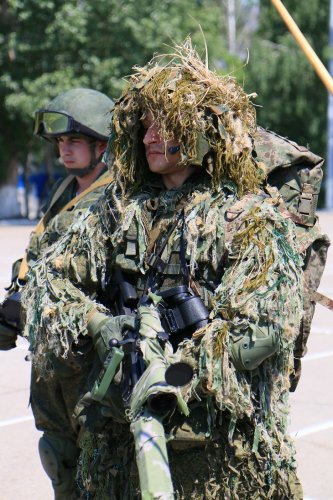
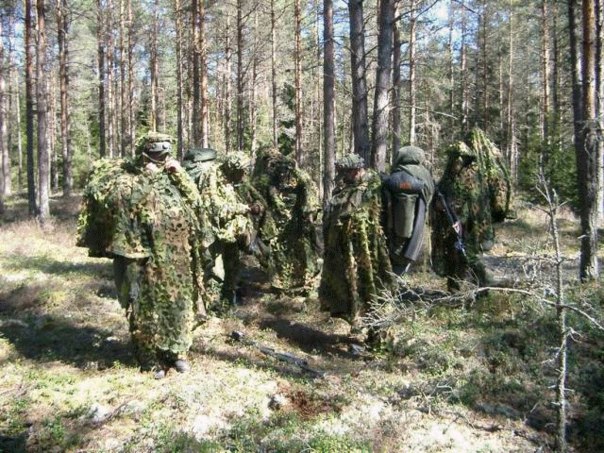
Operational Field Skills. Notes on disguise masking
Notes. Disguise masking – blending with the environment (C-I) : Read
Notes illustrations. Camouflage – masking, technique (C-I) : Read
.
.
Special Forces in Counter -Terrorism Engagement
GUEST FEATURE
COUNTER-TERROR OPERATIONS
.
USEFUL TO SEE. HOW OTHERS DO IT.
As stated, we can show others but not ourselves
.
Videos (I) – (VI) Note : 18 +
.
(I) The special operation of the FSB and the Interior Ministry in Dagestan p. Leninkent, RD, 13-14 04 2016
.
.
(II) Dagestan. The special operation of the FSB and the Interior Ministry in the area of taxiway with. Orochi, 11 03 2016
.
.
(III) The elimination of the underground network in Dagestan
.
.
(IV) Spetsnaz FSB. Dagestan (removed)
.
(V) The special operation of the FSB Special Forces (removed)
.
(VI) Special operation. Spetsnaz FSB and the Interior Ministry stormed a house in a. Zahit. Dagestan
.
/
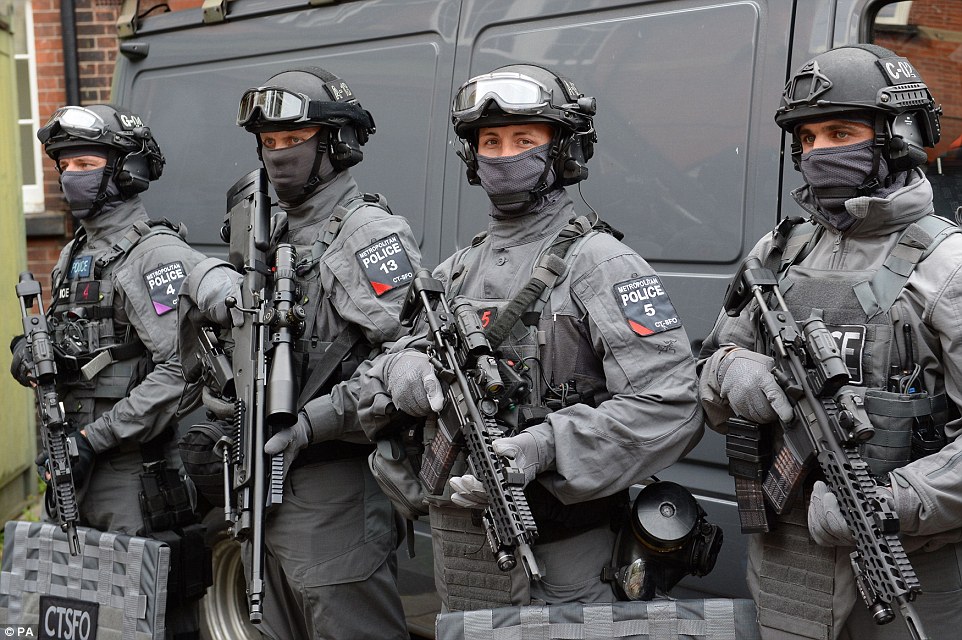
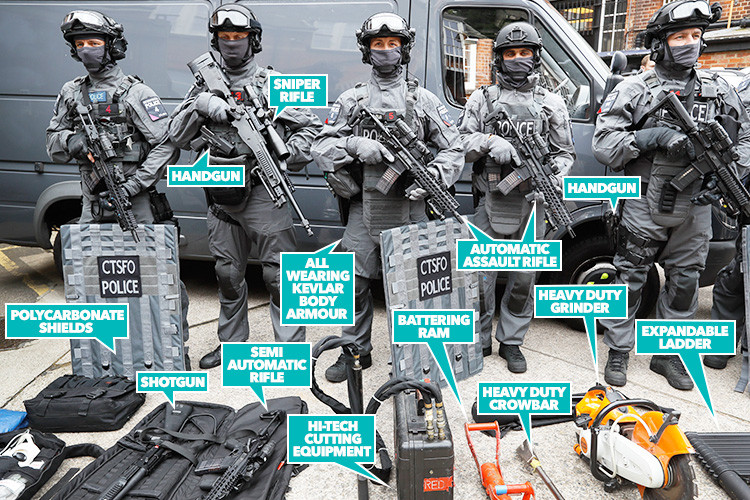
Metropolitan Police
.

.
.
Under Construction
Stay with us, be safe, be happy
.
Secret Intelligence Service
ADVERSITATE. CUSTODI. PER VERUM
.
.
.
.