.
Secret Intelligence Service
.
Relevant Reports in Brief
(III)
.
COUNTER-TERRORISM LIBRARY
.
.
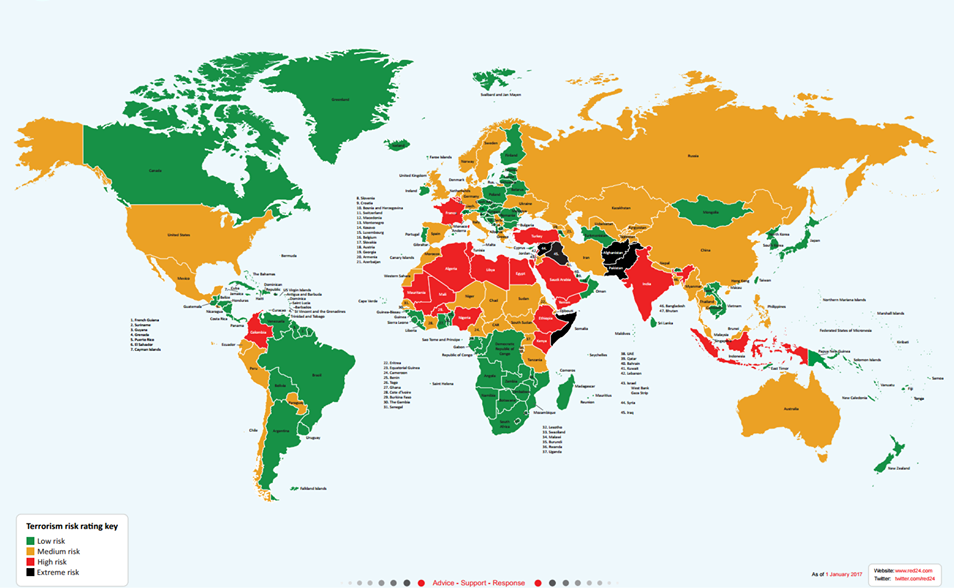
Terror Threat World Map. from 2017
.
> Enter the Counter-Terrorism Library <
.
UNIT
New radical Salafist terror cells are establishing across Europe, the Middle East and in Central Africa
Specifically, terror cells have been exposed within Russia, Belgium, Ireland, Iran, Saudi Arabia, Morocco, Tunisia, Egypt, Democratic Republic of Congo and Bangladesh
Islamic State fighters are discovering and developing territory, forming new cells following the obliteration of their caliphate in Iraq and Syria
Islamic State fighters departing Iraq and Syria are likely to be heading to Libya, where the terror group is already entrenched.
The Islamic State has several provinces who have sworn allegiance to Abu Bakr al-Baghdadi.
Incrementally it is expected that Islamic State will use this to develop more territory in countries further along the continent.
Four cells have been exposed in Libya’s neighbours; Tunisia and Egypt.
The terror group maintains sleeper cells in European countries, as well as in Middle Eastern countries; Saudi Arabia, Iran and the Gulf States.
The Islamic State has been active in Russia since mid-June 2015, when ‘The Islamic State of Iraq and the Levant. Caucasus Province’ was eformed. Two terror cells were destroyed in Moscow, leading to speculation and consequent alarm that they are spreading from the North Caucasus region and across the country.
.
Maute, in the Philippines (Islamic State of Lanao) pledged allegiance to Islamic State in 2015, launched an attack on the city of Marawi in May, as an attempt to establish a Filipino Islamic State caliphate.
As Islamic State have lost their territory in the Middle East, an increasing number of Islamist terrorists are seeking to join Maute, including Islamic State fighters who have left Iraq and Syria.
In Egypt, Islamic State partner Wilyat Sinai has been directing an Islamist militant insurgency in northern Sinai, which borders the Gaza Strip and Israel.
Wilyat Sinai has carried out several terror attacks under the Islamic State flag.
Islamic State in Somalia, officially established in October 2015, have been collaborating in the jihadist insurgency and have carried out several terror attacks.
West African terror group Boko Haram (Islamic State West Africa Province) exchanged their allegiance from Al-Qaeda to Islamic State, in March 2015.
Islamic State have provinces in countries; Yemen, Algeria, Afghanistan and Pakistan.
.
Relevant Reports
Relevant Reports
.
** Note that we cannot include all international event reports because of allotted space
Addendum
WESTERN AFRICA. BOKO HARAM : Boko Haram, the radical terror group in Nigeria have this year (2017) used more than 80 children as suicide bombers. Since early 2017, 83 children have been used to cause explosions, of which 55 are girls under the age of 15. This figure is four times higher than similar data for the past year.
Most of the suicide bombers of the terror group Boko Haram are women or children.
Data shows that from April 11, 2011 to June 30, 2017, Boko Haram sent 434 suicide bombers to 247 different targets during 238 attacks of suicide bombers, at least 56% of these suicide bombers were women. The suicide bombers – children and / or adolescents.
The increase in the number of women in suicide bombers began after the abduction of 276 Nigerian schoolgirls in Chibok.
This is the first terrorist group in history that uses more female suicide bombers than men, and it is at the forefront of using children as suicide bombers. There are several reasons for choosing women and children as suicide bombers. Among them, one can say that they are less likely to be searched, and also that women and children are much more receptive to the efforts of the recruiting group through violence, >> brainwashing << and other methods.
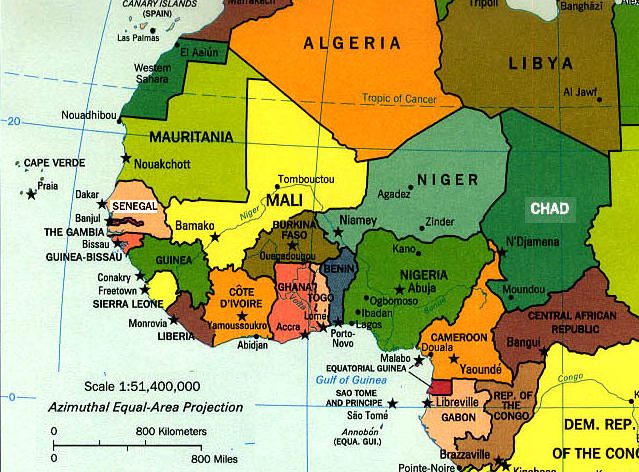
In Brief : Nigeria. Boko Haram الولاية الإسلامية غرب أفريقيا
THE CENTRAL AFRICAN REPUBLIC has become and remains a place of horrors. Thousands are still dying at the hands of soldiers and militia gangs or from untreated diseases such as malaria. Boys and girls as young as eight are pressganged into fighting between Christians and Muslims. There are reports of longstanding atrocities **; beheadings and public execution-style killings. Villages have been set alight.
** It is noted that here, includes an altogether new psycho-patholical dimension, inextricably worse to the word ‘atrocity’ – sufficiently bad in experience as does already persist.
The Central African Republic has for years attracted thousands of sado-psychopathic killers from the surrounding countries and quite literally stands in a quagmire of ongoing genocide. Yet many people in the West and curiously, would not locate the country on a map, despite the clue in its name.
The Anti-balaka, translation; anti-machete, for want of a civilised acronym, were / are a militia come terror group composed primarily of Christians, and surfaced after Djotodia rose to power. Reports still indicated that some members of Anti-balaka groups forcibly convert Muslims to Christianity.
In March 2016 was installed a politically independent candidate Faustin-Archange Touadera as president. He is working toward developing peace between the government and armed groups, and a disarmament, demobilization, reintegration, and repatriation programme to reintegrate the armed groups into society.
SOUTH ASIA. BANGLADESH : Ansar Bangla Team (from archive)
EAST AFRICA. Harakat al-Shabaab al-Mujahideen. حركة الشباب المجاهدين
The threat that al-Shabaab poses to the West cannot be understated. The group’s outreach to Muslims residing across Europe and the United States has been successful relative to other al-Qaeda-linked groups. The group has enticed dozens of foreign fighters from the West. It was the first jihadist group to recruit a US citizen to perform an act of suicide terror. Its approach to recruitment is therefore worthy of investigation; that is, how such jihadist groups formulate strategies to entice Western Muslims. From around 2011, approximately 1000 ethnic Somalis and 200 –300 non-Somalis have been recruited by al-Shabaab from outside Somalia. Radical Islam has been present in Somalia for decades, but cannot account for the group’s achievement in recruiting Western Muslims. The group has developed a sophisticated communications infrastructure and which takes advantage of nationalist, anti-Ethiopian and anti-Western sentiments that still persist within the Somali dispersion (as a repercussion from the Ethiopian invasion and occupation of Somalia during 2006). Al-Shabaab’s interaction with Muslims beyond its borders it appears, has not and does not count solely upon Islamist ideology.
How al-Shabaab recuits Western muslims – ** file in edit
The list of places in Europe and Africa that have suffered from jihadist terrorism has grown at a rapid rate: the seaside town of Grand-Bassam in Côte d’Ivoire, nightspots in Paris, and transport hubs in Brussels, London just to name just a few.
In Europe, investigations show that the Islamic State has established a network of terror cells that is far wider and deeper than all had previously believed. In Africa, the number of deaths from jihadist violence has quadrupled from 2013 to 2016, as Boko Haram, al-Shabaab, Islamic State, and others have launched attacks across the continent. With competition among groups affiliated with Islamic Sate and Al Qaeda heating up, the violence is likely to grow further.
The challenge for policymakers on both continents is to contain the rise of terrorism without eroding hard-won freedoms. Facing that challenge is the common calling; indeed, tackling it together is the only sustainable solution. In the face of transnational, global security threats – including jihadist terrorism, but also the spread of pandemics and the consequences of climate change – the need for much closer and more effective European-African cooperation has become increasingly clear.
The unprecedented number of jihadist attacks in multiple countries has demonstrated how vulnerable our societies have become and how transnational the threat is. No group illustrates the nature of the challenge more clearly than Islamic State. From its origins as a terrorist group capitalising on state failure in Iraq and Syria, it has spread like a virus from Afghanistan to Nigeria and carried out or inspired attacks as far abroad as Australia, the United States, the U.K. and the Philippines, just to name a few. And, in addition to its territorial conquests and physical networks of followers, Islamic State has established a firm foothold online – far more so than any other jihadist organization.
Combating Islamic State and similar groups will require a strategy for both battlefields – physical and digital. Such an approach does (and has) include/d military components, improved intelligence work, and better information sharing. But we need to do more than just suppress the jihadist virus; we must eradicate it. To that end, we must address the root causes of jihadism, and the conditions that allow it to thrive.
The recent series of setbacks that Islamic State has suffered in Iraq and Syria should not be interpreted as a sign of its impending demise. On the contrary, Islamic State and other groups are seeking new hosts and conditions that are favourable to their spread; all too often, they are finding them. African countries are at particular risk. Jihadist groups have repeatedly demonstrated their ability to exploit disorder and weak state structures. Islamic State’s advances in Libya are only one example.
Al Qaeda and Islamic State may have global aspirations, but their ability to penetrate a society is strongly influenced by local conditions. Jihadist organisations attempt to exploit discontent among marginalised groups in unstable societies. Thus, counter-jihadist strategies must focus on strengthening vulnerable states and eliminating the conditions that allow jihadist groups to take root. This effort is particularly urgent in North Africa, East Africa, and the Sahel, where jihadists are currently operating; but, over the medium to long term, other parts of the continent will also require attention.
According to United Nations projections, Africa’s population is expected to more than double during the next 30 years, from 1.19 billion to 2.48 billion. This presents both enormous opportunities and significant challenges. If countries are able to provide their citizens with the infrastructure and institutions needed to thrive, they will be among the twenty-first century’s most dynamic societies.
Should they fail to accomplish this, however, the result could be widespread, accelerated state collapse and the impoverishment and potential radicalisation of millions of people. Among the many horrific consequences of such an outcome would be mass migration toward Europe and other Western countries and the creation of fertile recruiting grounds for new generations of jihadists.
The importance of Africa’s development to the entire world should be self-evident. And yet, despite the high stakes, Europe – and the international community more broadly – have not yet devoted full attention and resources that the issue merits. Today, more than ever, it would be extremely unwise to allow that to continue. A strong partnership between Africa and Europe is on the horizon.
‘RAPE AS A WEAPON OF WAR – DIRTY WAR.’ DISCUSSION / SEMINAR. (C-I). UNIT
IT HAS BECOME MORE DANGEROUS TO BE A WOMAN THAN A SOLDIER DURING AN ARMED CONFLICT
Brodsworth. 24 02 2018
Secret Intelligence Service. (C-I)
We have discussed and documented this before, but I think we should recap because currently :
Health care professionals and humanitarian organisations working in conflict zones, particularly across the African continent (though not confined to, by any means) are still documenting the use of rape as a weapon of war, this from the ground and it reveals the absence of an adequate international response.
Rape in war is by no means a new phenomenon as we know, but its escalation as a deliberate, strategic and political tactic is now undeniable. Most victims are women and girls, but men and boys suffer too. Whether isolated or systematic, rape’s effects are absolutely devastating to individuals and damaging to whole communities. The physical consequences can include; unwanted pregnancies, sexually transmitted infections including HIV, and genital injury, all of which can leave women scarred, disabled, unable to conceive, and deemed unsuitable for marriage. The brutality of war rape is evident in genital mutilation, forced captivity, gang rapes in public or in front of family members, and rape with objects such as glass, sticks, gun barrels, and even machetes. Psychologically the effects are no less devastating. Traumatised by the event, women are often unable to care for their children or households, fear leaving their homes, can become socially ostracised and isolated, and may be rejected by their husbands, families, or communities.
First recognised as a problem internationally back in the mid-1990s when “rape camps” that enslaved women and girls were discovered in the former Yugoslavia, systematic rape is now understood not as an unfortunate but inevitable by-product of war, but instead as; q>> a defining tactic of modern conflicts <<.
Following the genocide in Rwanda, where an estimated 500,000 women were raped in 1994, a landmark decision by the International Criminal Tribunal recognised rape as a crime of genocide under international law. Mass rape has been documented for recent conflicts in Bangladesh, Burma, Columbia, Liberia, Sierra Leone, and Somalia.
The toll of the ongoing conflict in the Democratic Republic of the Congo is absolutely staggering : an estimated 5.5 million deaths, 1.5 million displaced people, and 500,000 victims of sexual violence since 1991. The recent escalation of fighting has fueled international press reports of a country more lawless than perhaps anywhere else on earth and where women are frequently and systematically victimised. This pandemic of sexual violence is obscene, insanely savage, and can only be described as femicide.
Reference to the Panzi Hospital in eastern Congo : ten women survivors of rape every day, this war on women, the monstrosity of the century.
In areas of armed conflict rape is committed mostly with impunity and has been largely ignored by the international community.
>> As a terror tactic, rape aims to destroy or expel populations or ethnic groups, impregnate women, intimidate civilians, pillage land and resources, and may serve to increase military morale. << Husbands or family members, sometimes forced to watch, are also traumatised. In refugee camps in Darfur and Chad, where hundreds of thousands of Sudanese people are displaced, women are essentially imprisoned because they cannot even travel to get firewood or water without risking being raped. In the Democratic Republic of Congo, different militia groups have distinct and recognisable ways by which they rape women, thus marking women with a signature that often mutilates and scars them for life, but also establishing the armed group’s power and control.
During the June 2008 UN meetings at which rape was officially classified as a weapon of war – the effect of rape as a war tactic was summerised, thus :
> It has become more dangerous to be a woman than a soldier during an armed conflict <<
RAPE AS A WEAPON OF WAR – DIRTY WAR. DISCUSSION / SEMINAR. UNIT (C-I).
Brodsworth. 24 02 2018 Secret Intelligence Service. (C-I)
.
SECRET INTELLIGENCE SERVICE
THE COUNTER-TERRORISM LIBRARY
.
Go to Relevant Reports Page (II)
Go to Relevant Reports Page (I)
.
> Enter the Counter-Terrorism Library <
.
SecretIntelligenceService.london
SecretIntelligenceService-defence.uk
SecretIntelligenceService.org
.
Enter the Counter-Terrorism Library
.

.
.
The United Kingdom
MMXVII
Adversitate. Custodi. Per Verum
.
.