.
Secret Intelligence Service
ISKANDER – RUSSIAN FEDERATION
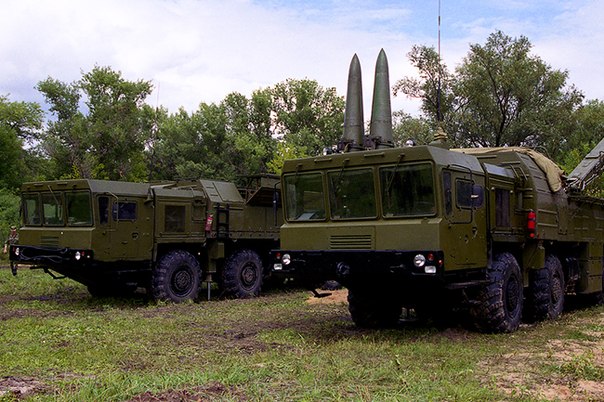
Operational-tactical missile system 9K720 ISKANDER
basing:
chassis
Control system:
software control
Warhead:
Spetsboepripasov, high-explosive, Penetrating, Cassette, Incendiary
application:
Land-Plot
country:
Russia
range:
up to 500 km.
Year of design:
1999
PTRC Iskander high-precision operational-tactical missile complex land forces 9K720 “Iskander” is designed for covert preparation and application of effective missile strikes on especially important Small and area targets in the depth of operational formation of the enemy: fire weapons (missiles, multiple rocket launcher systems, long-range artillery), aircraft and helicopters airfields, command posts and communications nodes, critical civilian infrastructure.
PTRC 9K720 created as a result of joint work group of research institutes, design bureaus and plants under the guidance of KBM (KBM Kolomna), known as the founder of the firm-missile complexes “Point”, “Oka”. Launcher developed CDB “Titan” (Volgograd), homing system – Central Research Institute of Automatics and Hydraulics (Moscow).
In the context of the action of the INF Treaty of 1987 and the non-use of nuclear weapons in the theater to modern tactical systems presented a number of new requirements:
Use only non-nuclear weapons;
providing precise shooting accuracy;
management throughout the flight path;
wide range of effective combat equipment;
the presence of complex automation systems command and control and information management system, including the preparation of standard information systems for correction and final guidance;
the possibility of integration of global satellite navigation systems (SISS – “Glonass”, “NAVSTAR”);
the possibility of defeat heavily defended targets;
increase fire performance;
the ability to effectively overcome the effects of air defense and missile defense;
opportunity to engage moving targets.
To meet the above requirements established export version PTRC 9K720, designated “Iskander-E”. “Iskander-E” incorporates the best scientific, technical and design achievements in the field of tactical missile systems and jointly implemented technical solutions, high combat effectiveness an entirely new generation of weapons, superior to their tactical and technical characteristics of the existing RC 9K72 “Elbrus”, “Tochka-U”, “Lance”, “ATASMS”, “Pluton” and others.
The main features of the RK 9K720 “Iskander”:
highly accurate and effective engagement of different types of targets;
the possibility of covert preparation, alert and effective missile strikes;
automatic calculation and entering flight mission missile launcher means;
a high probability of a combat mission in the face of strong opposition from the enemy;
high probability of trouble-free operation of the rocket in preparation for launch and in flight;
high tactical maneuverability thanks to all-terrain military vehicles, mounted on four-wheel drive chassis,
strategic mobility through the transportability of machines all modes of transport, including transport aircraft;
automation of combat control missile units,
timely processing and bringing intelligence to the appropriate levels of management;
long life and ease of use.
“Iskander-E” in their tactical and technical characteristics is fully consistent with the position of Control Regime proliferation of missile technology. This is the “weapon of deterrence” in local conflicts, and for countries with limited living space – a strategic weapon. The structure of the complex, its management systems, automated command and control and information systems to rapidly respond to new requirements without substantial revision of its weapons of war and, therefore, guarantee a long life cycle.
For the Russian Army missile system developed variant “Iskander-M” with extended range (over 450km) and “Iskander-K”, equipped with high-precision cruise missile P-500 (range up to 2600 km) of “Caliber” development of Yekaterinburg “OKB” Innovator “. The complex successfully tested in 2007. at Kapustin Yar.
In 2007, the complexes “Iskander-M” (four combat vehicles) was equipped with a training division in Kapustin Yar, who participated in the war with Georgia in August 2008
In the west complex has received the designation SS-26.
structure
Rocket 9M723V complex includes:
9M723 missile;
self-propelled launcher 9P78 (SDA);
transport and loading vehicle 9T250 (TPM);
command and staff vehicle 9S552 (CSV);
mobile unit training information 9S920 (PPI);
machine regulation and maintenance (MRTO);
Machine livelihoods;
Arsenal kits and the training equipment.
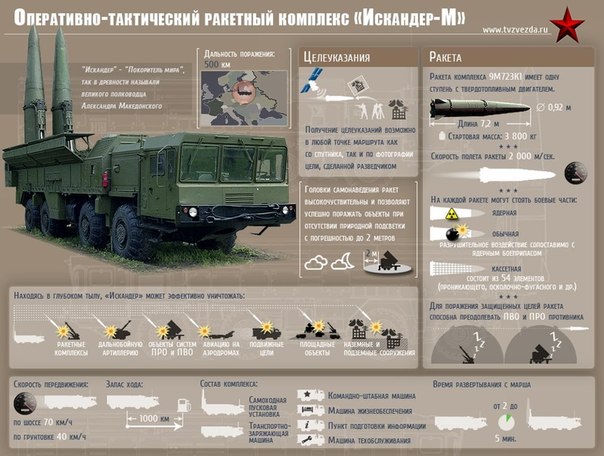
9M723 missile – solid fuel, single stage with a non-detachable warhead in flight. The missile is controlled throughout the flight path by a gas-dynamic and aerodynamic rudders. The flight path is not 9M723 ballistic and controlled. The rocket plane is constantly changing trajectory. She has been particularly active in the area of his maneuvers and acceleration approach to the goal – with an overload of 20 to 30g. In order to intercept a missile 9M723, antimissile must move along a path with an overload of two to three times higher, and it is virtually impossible. Most of the trajectory the rocket technology with ‘stealth’ and having a small reflecting surface is at an altitude of 50 km, which also significantly reduces the likelihood of its defeat the enemy. Effect ‘invisibility’ is achieved by a combination of design features and special coating processing missiles.
Directly on the target missile is displayed using the c inertial control system, and then captured autonomous correlation-extreme optical homing head (see photo). The operating principle of homing OTP 9M723 is that the optical apparatus forms an image of the terrain in the target area, which is compared to an onboard computer with an introduction to the preparation of a model rocket for launch. The optical head has a high resistance to existing electronic warfare and allows the successful launch even on moonless nights, when there is no more natural lighting goals, hitting the target with an accuracy of plus or minus two meters. A similar problem, but “Iskander”, can not solve any one tactical system in the world. In addition, the optical system does not require signals from space navigation systems, which in cases of crisis can be turned off or disabled by radio interference. Integration of inertial control with satellite navigation and optical seeker allows you to create a missile strikes a given target almost any conceivable circumstances. Seeker can also be used for ballistic and cruise missiles of various classes and types.
The missile can be equipped with different combat units (total of 10 types), incl .:
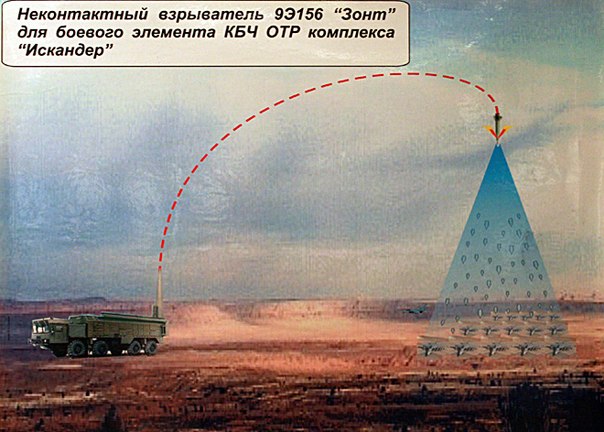
cassette warhead with fragmentation sub-munitions non-contact undermining;
cassette warhead with cumulative fragmentation sub-munitions;
cassette warhead sub-munitions with self;
cassette warhead detonating space-action;
high-explosive fragmentation warhead (OFBCH);
high-explosive incendiary warhead;
penetrating warhead (COEP).
Cassette warhead provides disclosure at the height 0.9-1.4km with further separation and stabilization of combat elements. Combat elements are equipped with radio sensors, undermining the combat elements are at the height of 6-10m above the target.
Through the implementation of terminal management and guidance, control the entire flight path, a wide range of powerful combat units and providing aggregation SU board with different systems of correction and homing, and the high probability of a combat mission in the face of strong opposition from the enemy target types are affected only 1 start 2 missile Kazakhstan “Iskander-E”, which is equivalent to the effectiveness of the use of a nuclear weapon.
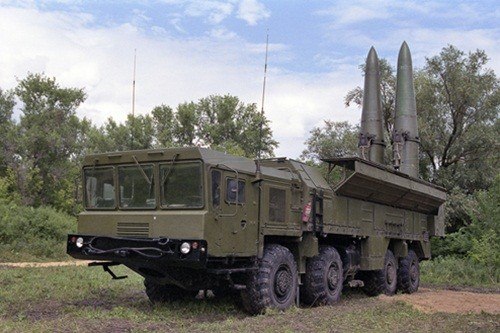
Fully autonomous SPU placed on a wheeled chassis 8×8 terrain (MZKT-7930) and is intended for storage and transportation of missiles, launch preparation and start shooting within a sector of ± 90 ° relative to the direction of arrival of the STC. STC provides automatic identification of their coordinates communication with all levels of government, alert and preparing to launch rockets finding in a horizontal position, and a single salvo missile launching, storage and testing of missiles. The most important feature of the launcher has been placed on it is not one (as in the “point” and “Oke”), and two missiles. Time Spent launcher on the launch pad and a minimum of 20 minutes, the interval between starts of the 1st and 2nd rockets less than a minute. For rocket launches do not require specially trained in engineering and surveying against starting positions, which may lead to the disclosure of their opponent. Triggers can be made of the so-called “readiness to march,” ie, launcher calls in to any site (except marshland and loose sands) and its calculation in an automated cycle, without leaving the cab provides training and launch. Then the launcher moves to point and recharge after loading missiles ready to spray again missile attack from any starting position.
TPM is also placed on the chassis MZKT-7930 and has a jib crane. Full combat weight – 40000kg, calculation TLV – 2 persons.
Automated control system is based on the unified for all levels of management command and staff vehicles performed on the chassis KAMAZ family. Setting up a certain level of control (brigade, division, starting battery) is carried out by software during operation. To ensure the exchange of information in the launcher available equipment combat control and communications. Information exchange can take place both in open and in closed channels.
“Iskander-E” is integrated with different systems of intelligence and management. Information about the defeat is transmitted from the satellite, reconnaissance aircraft or unmanned aerial vehicle (such as “Reis-D”) in the preparation of the information point (PIP). It is calculated flight mission for missiles and is preparing reference information for missiles with OGSN, then this information by radio broadcast on command and staff vehicles (CSV) battalion commander and the battery, and then – on the launchers. Start command the missile can be formed as a crank, and come from the control points of senior artillery commanders.
Machine regulation and maintenance (MRTO) is located on the chassis of the family, “KAMAZ” and is designed for routine test missiles onboard equipment placed on the TLV (as well as in containers), check the devices included in the group of elements of the complex sets of spare parts and maintenance of missile forces MRTO calculation. Machine weight – 13500kg, deployment time – 20 min., While the automated cycle routine test onboard equipment rockets – 18min., The calculation – 2 persons.
Life-support machine is designed to accommodate crews (of up to 8 people) for rest and food.
Performance characteristics
Range, km:
– Minimum 50
– Maximum 280 (400)
Accuracy (CWE), m:
– Without homing 30-70
– With homing system 5-7
Number of missiles:
– For SDA 2
– At TLV 2
Start time of the first rocket, m:
– Higher readiness of not more than 4
– With no more than 16 march
The interval between starts, minutes to 1
Service life, 10 years (including 3 years in the field)
Temperature range, ° C up to ± 50
Height above sea level up to 3000 m
rocket
The starting weight of the rocket, kg 3800
Warhead weight, kg 480
Length mm 7200
The maximum diameter in mm:
– On a rope collars 950
– On the engine 920
SPU
Gross weight, t 42
Mass placed load 19 m
Maximum speed, km / h:
– On Highway 70
– On a dirt road 40
Cruising on the control fuel consumption, km 1000
Crew 3
CSV
Number of workstations, pc. 4
Maximum range radio km
– In the parking lot-350
– On the march -50
Time calculation combat mission, with up to 10
The maximum transmission time teams from 15
The number of channels to 16
Transmission rate (reception) data kbit / c 16
Time expand / collapse (with expand / collapse antennas), up to 30 minutes
Operating time, 48 hours
PPI
Number of workstations, pc. 2
Time coordinates of the target point determination, from 0.5 minutes to 2
Time taken to targeting to SDA, min 1
Operating time, 16 hours
Video: To operate > Hit the coloured square at top left > Hit close library at bottom right > Play
removed
removed
ARCHIVE
.
Secret Intelligence Service
ADVERSITATE. CUSTODI. PER VERUM