.
Secret Intelligence Service
Unit
.
.
Chronology of the British Armed Forces
.
1633 – The Royal Regiment of Foot (later the Royal Scots) is placed on the Scottish Establishment, later becoming the oldest infantry regiment in the British Army.
1642 – Marquis of Argyll’s Royal Regiment was raised by Archibald Campbell, 1st Marquess of Argyll for service in Ireland, renamed in 1650 Lyfe Guard of Foot and reformed as the Scottish Regiment of Foot Guards in 1661 (later the Scots Guards).
1650 – George Monck’s Regiment is formed (later the Coldstream Guards), becoming the oldest infantry regiment in continuous service in the British Army but not under the Monarch.
1656 – Lord Wentworth’s Regiment is formed (later the Grenadier Guards), later becoming the most senior infantry regiment in the British Army because of the long serving loyalty to the monarch during the English Civil War.
26 January 1661 – King Charles II issues warrant, becoming the acknowledged beginning of the British Army. This concerned an assemblage of English regiments and Scottish regiments brought south with Charles II. The British Army would not formally exist, however, for another 46 years, as Scotland and England remained two independent states, each with its own Army.
1 October 1661 – The Tangier Regiment is formed, later The Princess of Wales’s Royal Regiment, the most senior English infantry regiment in the British Army.
1684 – The English withdraw from the Colony of Tangier.
1688 – The War of the Grand Alliance begins.
1702 – War of the Spanish Succession begins.
1707 – Kingdom of Great Britain is formed. Scottish and English armies merged to create the British Army.
1722 – Royal Regiment of Artillery is formed.
1742 – War of the Austrian Succession begins.
1743 – Battle of Dettingen, King George II becomes the last British monarch to lead his troops into battle.
1746 – Battle of Culloden, The British Army, made from Scottish and English soldiers and led by the Duke of Cumberland, fights the last major battle on British mainland soil against French supported Scottish rebel Jacobites.
1751 – A numerical system is introduced into the Army, such as 1st Regiment of Foot, 2nd Regiment of Foot . . .
1755 – Seven Years’ War begins.
1759 – Battle of Minden, the Duke of Brunswick leads an Anglo-German army against the French.
– British forces, led by General James Wolfe, take French Quebec.
1775 – American War of Independence begins.
17 June – Battle of Bunker Hill.
1776 – British victory at the Battle of Long Island.
1777 – British victory at the Battle of Brandywine.
1777 – British defeat at the Battle of Saratoga.
1781 – British defeat at the Siege of Yorktown.
1793 – War on revolutionary France declared.
1795 – Capture of Ceylon.
1796 – slave forces in Haiti led by Toussaint L’ouverture British Forces defeated.
1798 – Large-scale rebellion in Ireland.
1799 – Capture of Seringapatam.
– The United Kingdom of Great Britain and Ireland is formed.
French Revolutionary Wars (A campaign to expel a French invasion force in Egypt) takes place.
1803 – The Napoleonic Wars begin.
1803 – Second Anglo-Maratha War begins, ends 1805
1 September – Battle of Aligarh
11 September – Battle of Delhi
23 September – Battle of Assaye
1 November – Battle of Laswari
28 November – Battle of Argaon
15 December – Battle of Gawilghur
1806 – Seizure of the Cape of Good Hope.
– An invasion (initially unauthorised) of Spanish South America begins.
1808 – The Peninsular War begins.
16 January – Battle of Corunna
1810
24 July – Battle of the Côa
25 July – Siege of Almeida (1810)
27 September – Battle of Bussaco
1811
19 February – Battle of the Gebora
3 April – Battle of Sabugal
14 April – Siege of Almeida (1811)
3 May – Battle of Fuentes de Onoro
16 May – Battle of Albuera
25 May – Battle of Usagre
28 October – Battle of Arroyo dos Molinos
1812 – The War of 1812 against the United States begins.
7 January – Siege of Ciudad Rodrigo
16 March – Battle of Badajoz (1812)
11 April – Battle of Villagarcia
11 June – Battle of Maguilla
22 July – Battle of Salamanca
23 July – Battle of Garcia Hernandez
11 August – Battle of Majadahonda
19 September – Siege of Burgos
23 October – Battle of Venta del Pozo
1813
21 June – Battle of Vitoria
7 July – Siege of San Sebastián
25 July – Battle of the Pyrenees
25 July – Battle of Roncesvalles (1813)
25 July – Battle of Maya
28 July – Battle of Sorauren
7 October – Battle of the Bidassoa (1813)
19 November – Battle of Nivelle
9 December – Battle of the Nive
1814 – The Gurkha War begins.
15 February – Battle of Garris
27 February – Battle of Orthez
10 April – Battle of Toulouse (1814)
14 April – Battle of Bayonne
1815
8 January – Battle of New Orleans
16 June – Battle of Quatre Bras
18 June – The Battle of Waterloo takes place, ending in defeat for the French.
1819
16 August – The Peterloo Massacre takes place.
1839 – First Anglo-Afghan War begins ends 1842
23 July – Battle of Ghazni
September – Siege of Kahun
1842
6 January – Battle of Gandamak
15 January – Massacre of Elphinstone’s Army
August – Battle of Kabul (1842)
1854 – The Crimean War begins; ends in 1856.
19 September – The Siege of Sevastopol begins.
20 September – The Battle of Alma takes place.
25 October – The Battle of Balaklava takes place; Charge of the Light Brigade.
5 November – The Battle of Inkerman takes place.
1855
8 September – The siege of Sevastopol ends.
1857 – The Indian Mutiny begins.
30 May – Indian rebels begin the Siege of Delhi, Siege of Lucknow
5 June – Siege of Cawnpore begins
8 June – Battle of Badli-ki-Serai, Siege of Delhi
30 June – Siege of Lucknow begins, Battle of Chinhat
25 August – Battle of Najafgarh
11 October – Battle of Agra
19 November – Second Battle of Cawnpore
1858
Central India Campaign (1858)
1 March – Capture of Lucknow
1859 – Due to fear of invasion by France, a volunteer movement begins, known as the Volunteer Rifle Corps.
1870 – The Army withdraws from Australia and New Zealand.
1871 – The Army adopts the Martini-Henry rifle, replacing the Snider.
– Abolition of the purchase of commission.
1878 – Second Anglo-Afghan War begins, ends 1880
21 November – Battle of Ali Masjid
15 December – Siege of the Sherpur Cantonment
1879 – The Anglo-Zulu War takes place.
22 January – British force defeated at Battle of Isandlwana.
The defence of Rorke’s Drift begins; eleven Victoria Crosses would be gained in the process.
1880
19 April – Battle of Ahmed Khel
27 July – Battle of Maiwand
1 September – Battle of Kandahar
20 December – First Boer War begins ends 23 March 1888
20 December – Action at Bronkhorstspruit takes place
1881 – Sudan Campaign begins, ends 1889
28 January – Battle of Laing’s Nek
1 July – General Order 70, the culmination of the Cardwell-Childers reforms of the Army’s organisation, came into effect.
1884
13 March – Battle of Tamai
22 March – Battle of Tofrek
1885
January – Battle of Abu Klea
28 January – General Charles George Gordon is killed by Mahommed Ahmed (the self-proclaimed Mahdi) after his siege of Khartoum; British relief force arrives two-days later.
8 February – Battle of Schuinshoogte
10 February – Battle of Kirbekan
27 February – Battle of Majuba Hill
30 December – Battle of Ginnis
1889 – The Maxim machine gun is introduced.
3 August – Battle of Toski
1896
7 June – Battle of Ferkeh
1898
8 April – Battle of Atbara
2 September – Battle of Omdurman
24 November – Battle of Umm Diwaykarat
Second Boer War
1899
11 October – War is declared.
20 October – The first major battle of the war takes place at Talana Hill.
December – “Black Week”, in which the Army suffered a series of defeats, takes place.
1900
28 February – The Siege of Ladysmith is lifted.
1 April – The Irish Guards is formed in honour of the Irish regiments in the Boer War.
17 May – The Siege of Mafeking comes to an end.
1902
31 May – War ends with the signing of the Treaty of Vereeniging.
1905 – The 5th Battalion, The Royal Garrison Regiment is the last British battalion to leave Canada.
1908 – The Territorial Force (later Army) is formed.
1911
1 April – Following an order issued on 28 February, the Air Battalion Royal Engineers is formed.
1912 – The Vickers machine gun is introduced into the Army; it remains in service until1968.
13 May – The Air Battalion Royal Engineers becomes the Royal Flying Corps. It remains part of the Army.
First World War
1914
– Britain declares war on Germany.
August – British Expeditionary Force begins to deploy to France.
19 October – The First Battle of Ypres begins in Belgium.
1915
26 February – The Welsh Guards becomes the last Foot Guards regiment to be formed.
25 April – Landings at Helles, Gallipoli.
10 August – Landings at Suvla Bay, Gallipoli.
22 October – The Machine Gun Corps is formed.
1916
April – The Easter Rising in Dublin takes place .
1 July – The First Day of the Somme begins; about 60,000 casualties are incurred, 20,000 of whom had been killed.
1917
28 July – The Heavy Branch of the Machine Gun Corps is split off to form the Tank Corps (later the Royal Tank Regiment).
8 November – About 200 men of the Warwickshire Yeomanry and Worcestershire Yeomanry charge with sabres drawn and defeat an Ottoman battery and a large group of Ottoman infantry at Huj. It was one of the last cavalry charges by the British Army.
20 November – The Battle of Cambrai begins; sees the first large-scale use of tanks.
December – The Capture of Jerusalem takes place.
1918
11 November – The First World War ends with the signing of the Armistice.
January 1919 – Anglo-Irish War begins; British forces combat guerilla operations by the Irish Republican Army.
1919 – British Army takes part in Allied intervention during Russian Civil War.
31 July 1922 – Six Irish regiments (5 infantry and one cavalry) are disbanded due to the establishment of the Irish Free State.
5 August 1922 – The Royal Corps of Signals is formed.
1929 – The British Army of the Rhine in Germany is withdrawn.
1935 – Abyssinian Crisis takes place; Army deploys substantial reinforcements to Africa and the Middle East.
1936 – uprising in Palestine begins.
4 April 1939 – The Royal Armoured Corps is formed.
Second World War
1939
3 September 1939 – Britain enters the Second World War when it declares war, along with its Allies, on Nazi Germany.
September 1939 – British Expeditionary Force begins to land in France.
17 May 1940 – The Local Defence Volunteers (later the Home Guard) is formed.
20 May 1940– In France, British armoured units counter-attack at Arras.
26 May 1940 – The Dunkirk evacuation begins; over 330,000 British and French soldiers are evacuated by 4 June.
22 June 1940 – The Parachute Corps (later The Parachute Regiment) is formed.
April 1941 – Germany invades Crete; Army and Commonwealth forces eventually evacuated by Royal Navy.
25 December 1941 – The garrison at Hong Kong surrenders to the Japanese.
15 February 1942 – Singapore garrison surrenders to Japanese forces.
23 October 1942 – Second Battle of El Alamein takes place; Montgomery’s British Eighth Army defeats the Africa Corps in in offensive.
1943 – The Allied invasion of Sicily begins.
1943 – Invasion of Italian mainland begins.
March 1944 – The Japanese launch their offensive against India; battles of Imphal and Kohima takes place.
1 April 1944 – The Special Air Service Regiment is formed to administer existing SAS units.
6 June 1944 – in airborne operations prior to D-Day landings, Pegasus and Horsa Bridges are taken by D Company, 2nd Ox & Bucks, and the Merville gun battery is destroyed by the 9th Parachute Battalion.
6 June 1944 – The D-Day landings take place; British Army lands at Gold and Sword; some British units allocated to Canadian beach at Juno.
18 July 1944 – Allied armoured offensive, Operation Goodwood, begins.
September 1944 – Operation Market Garden takes place.
24 March 1945 – Airborne crossing of the Rhine, Operation Varsity, takes place.
8 May 1945 – VE Day.
2 September 1945 – Formal surrender of Japan.
1 January 1948 – Four Gurkha regiments are transferred from the Indian Army to the British Army, forming the Brigade of Gurkhas.
28 February 1948 – The 1st Battalion, Somerset Light Infantry becomes the last British regiment to leave India.
1948 – The Malayan Emergency begins.
1948 – The Army withdraws from Palestine.
1 January 1949 – National Service, the new name for conscription, is introduced.
1 February 1949 – The Women’s Royal Army Corps is formed.
1950 – The Korean War begins.
22 April 1951 – The Battle of the Imjin River takes place.
1952 – The Mau Mau uprising in Kenya begins.
1953 – The Army withdraws its garrison from Bermuda.
1954 – The last troops leave Trieste, having been there since 1945 as part of British Forces Element Trieste.
1955 – Occupying troops leave upon Austrian independence.
June 1956 – Last British troops leave the Suez Canal Zone, Egypt.
31 October 1956 – Operation Musketeer, the invasion of Suez begins.
5 November – 3rd Battalion, The Parachute Regiment dropped at El Gamil airfield.
6 November – Amphibious landings take place; Army Centurion tanks land in support.
1 September 1957 – The Army Air Corps is formed.
1957 – The Sandys Review of the armed forces takes place.
1958 – July – 16 Independent Parachute Brigade Group (less 3 Para), air-landed in Amman, Jordan from Cyprus.
1961 – Army deploys troops to Kuwait after its request for British to deter invasion by Iraq.
1962 – The Brunei uprising takes place.
1963 – Last National Serviceman is discharged from the Army.
1967 – Withdrawal from Aden after a period of time known as the Aden Emergency.
1968 – The only year in the century when the British Army lost no soldiers in action.
August 1969 – British troops deployed to Northern Ireland to assist in stopping sectarian violence. It is the beginning of The Troubles.
5 May 1980 – Special Air Service ends the Iranian Embassy siege.
2 April 1982 – Falklands War begins.
28 May – 2nd Battalion, The Parachute Regiment (2 Para) defeat Argentinians at Goose Green.
8 June – Bombing of RFA’s Sir Galahad, Sir Tristram kills 48, including 32 Welsh Guards.
12 June – 3 Para defeats the Argentinians at Mount Longdon.
14 June – 2 Para takes Wireless Ridge.
14 June – 2nd Battalion, Scots Guards defeat Argentinians at Mount Tumbledown.
14 June – Falkland Islands are liberated upon the surrender of Argentinian forces.
1991 The Gulf War begins; Army contributes 28,000 troops.
1991 – The last British Army regiment leaves Gibraltar. The Gibraltar Regiment is subsequently placed on the Army’s regular establishment.
6 April 1992 – the WRAC was disbanded and its members integrated into various British Army units.
1 October 1992 – I (BR) Corps is disbanded and replaced by the Allied Command Europe Rapid Reaction Corps.
1992 – British forces deployed to Bosnia as part of UNPROFOR.
31 March 1994 – The British Army of the Rhine is disbanded and replaced by British Forces Germany.
1994 – The main force of the Army garrison in Belize is withdrawn; small detachment remains as part of British Army Training and Support Unit Belize.
1994 – 1st Battalion, The Queen’s Lancashire Regiment becomes the last British battalion to leave Berlin.
30 June 1997 – 1st Battalion, The Black Watch (Royal Highland Regiment) becomes the last British unit to leave Hong Kong.
1998 – The Strategic Defence Review white paper is published.
1999 – Kosovo War begins.
2000 – 2 PARA arrived in Freetown, Sierra Leone to evacuate British, Commonwealth and EU citizens.
2000 – The Army deploys to the Republic of Macedonia.
7 October 2001 – U.S. invasion of Afghanistan begins. The SAS was, initially, the main Army contribution.
December 2001 – Major-General John McColl takes command of ISAF in Afghanistan.
20 March 2003 – The US-led invasion of Iraq begins.
27 March 2003 – The largest tank engagement by the British Army since WWII takes place; 14 Challenger 2 tanks of the Royal Scots Dragoon Guards destroy 14 Iraqi T-55s.
6 April 2003 – British forces, led by 7 Armoured Brigade (The Desert Rats) enter Iraq’s second city of Basra.
2004 – The defence white paper ‘Delivering Security in a Changing World is published.
March 2005 – Private Johnson Beharry of the 1st Battalion, Princess of Wales’s Royal Regiment is awarded the Victoria Cross for his actions in Iraq in 2004.
6 April 2005 – The Special Reconnaissance Regiment became operational.
.
.
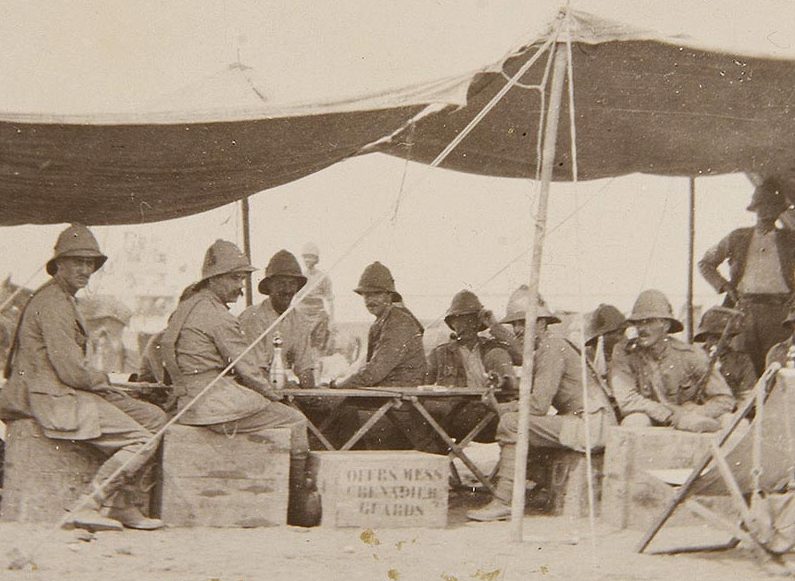
Atop illustration : Officers Mess. Grenadier Guards. While on campaign in the Sudan. 1898
.
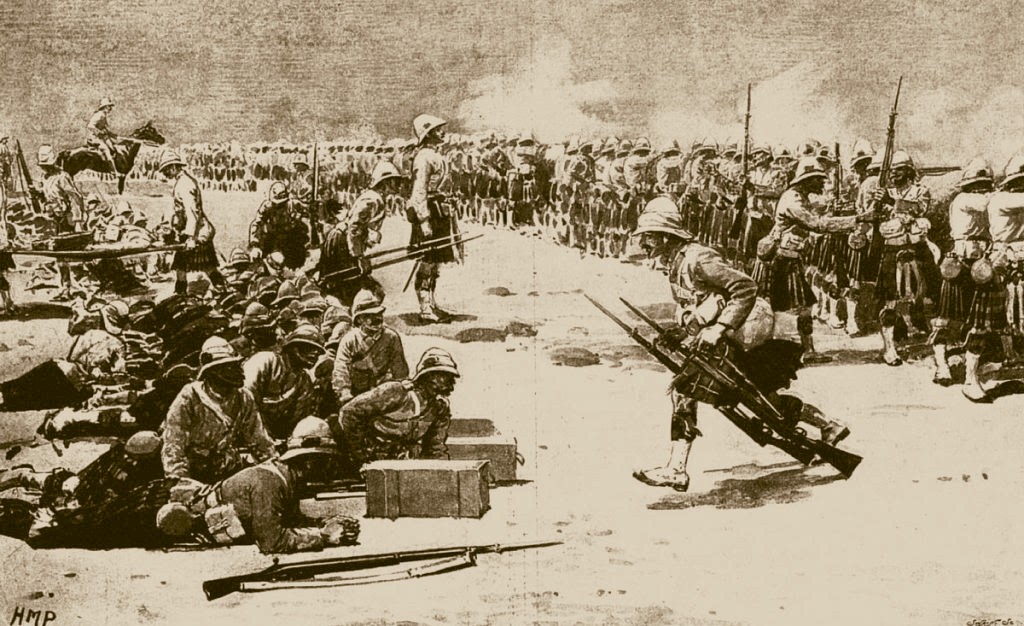
Below illustration : General Sir Herbert Kitchener at Omdurman. 2nd. Sept 1898. The defeat the army of Abdullah al-Taashi, the successor to the self-proclaimed Mahdi, Muhammad Ahmad. General Kitchener was seeking revenge for the 1885 death of General Gordon.
.
Chronology of the British Armed Forces
.
Secret Intelligence Service
Adversitate. Custodi. Per Verum
.
