.
中國人民共和國
.
The People’s Republic of China
.

1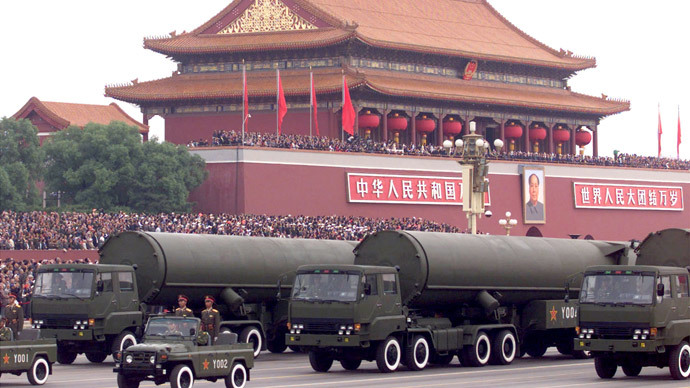
7/05/2015
Topic : Multiple Independently-targeted Reentry Vehicle technology (MIRV)
China is fast refurbishing its arsenal of silo-based long-range ballistic missiles to carry multiple independently targetable warheads, defense experts say. The move comes decades after Beijing acquired the technology, indicating a strategy change.
It has been speculated on for years that the Chinese military is upgrading some of its bigger ICBMs with Multiple Independently-targeted Reentry Vehicle technology (MIRV), which allows a single missile to carry multiple warhead across the globe and deploy them to aim at individual targets.
The assessment was endorsed by the US government in the latest Pentagon report on Chinese military might, which marked Dongfeng-5 missiles, China’s large liquid-propellant rocket capable of reaching the US, as MIRV-capable. The same report said Dongfeng-41, smaller solid-propellant road-mobile ICBMs “were capable of carrying MIRVs.”
As many as half of China’s 20 DF-5 missiles likely have been upgraded . With a conservative estimate that each missile would carry three individual warheads, it increases the number of warheads that Beijing may fire at an enemy to 40, up from 20.
China is probably upgrading its arsenal in response to the buildup of the global anti-ballistic missile system by the US. Washington says it needs the system to protect itself and its allies from an attack by nations such as Iran and North Korea. But strategists in Moscow and Beijing see it as threat to the national security of their respective countries.
It is ironic that the US missile defense system – intended to reduce the threat to the United States – instead would seem to have increased the threat by triggering development of MIRV on Chinese ballistic missiles that could destroy more US cities in a potential war.
The Pentagon report states that China is developing a number of technologies to penetrate antimissile shields.
“China is working on a range of technologies to attempt to counter US and other countries’ ballistic missile defense systems, including maneuverable reentry vehicles (MaRV), MIRVs, decoys, chaff, jamming, and thermal shielding,” it said.
China reportedly has had the technology needed to miniaturize nuclear warheads sufficient to fit several of them on one missile for decades, but chose not to upgrade its arsenal. Beijing’s nuclear deterrence strategy is to have sufficient weapons that they could survive a nuclear attack and deliver monumental damage to the aggressor.
“This is obviously part of an effort to prepare for long-term competition with the United States,” Ashley J. Tellis, a senior associate at the Carnegie Endowment for International Peace and a senior national security official in the George W. Bush administration, told NYT. “The Chinese are always fearful of American nuclear advantage.”
The expansion of China’s once small but powerful nuclear arsenal may trigger similar efforts from other nuclear powers in the region – India and Pakistan. So far only the US, Russia, Britain and France have deployed MIRVed ICBMs.
Moscow has indicated that it may see fit to stockpile more nuclear weapons depending on US foreign policies. The warning came from Mikhail Ulyanov, chief of the non-proliferation department in the Russian foreign ministry, who is attending a UN conference on the Nuclear Non-Proliferation Treaty.
The Russian diplomat was speaking about the New-START nuclear reduction treaty signed by the US and Russia in 2010, saying Moscow is sticking to its commitments, but would not go any further due to US behavior.
“The things the Americans are doing objectively hampers if not completely eliminates any prospect of further nuclear disarmament,” Ulyanov said.
“As of now there are no factors that would make our continued participation in the [New START] treaty counter to Russia’s interest, but hypothetically such a situation may arise from US actions, which we would not want to see,” he added.
The US and Russia have parity in nuclear weapons, but America has far more conventional forces. With Russia relying on its nuclear arsenal to safeguard it from a massive US attack, the development of the US anti-missile system is viewed as a dangerous threat to national security in Moscow.
.
 .
.

Secret Intelligence Service
Adversitate. Custodi. Per Verum